

You just got home from the pet store with a beautiful new betta. The staff said it was a female. Now you're not so sure. Maybe the fins look longer than expected. Maybe there's no visible egg spot. Sound familiar?
Misidentifying a betta's sex is more common than most people realize, and the consequences can range from accidental breeding to serious aggression injuries. Getting this right matters, whether you're planning a sorority tank, a breeding setup, or just want to make sure your single betta is truly alone.
This guide walks through every reliable physical marker, a step-by-step identification method, and the most misunderstood topics like sorority tank compatibility and what to do when males and females accidentally end up together.
Why Knowing Your Betta's Sex Actually Matters
This isn't just a curiosity question. The sex of your betta directly determines how it can be housed, who it can live with, and what behavior you should expect. Getting it wrong can lead to real harm.
What Happens If You House Two Males Together
Two male bettas in the same tank will almost always fight. It's not a matter of personality, it's instinct. Males are hardwired to defend territory, and a shared tank triggers that response immediately.[2]
In most cases, injury begins within minutes of introduction. Fins get shredded first, then scale damage follows. Even if neither fish dies outright, chronic stress from a shared space suppresses their immune systems and leads to disease over time. An aquarium divider is not a long-term solution either, because visual contact alone stresses males when they can see a rival constantly.
Watch for early warning signs: flared gills held out for extended periods, a darkened body color with stress stripes, and refusal to eat. These behaviors are your signal to separate immediately.
Accidental Breeding Risks from Misidentification
Putting an unintended male and female together in the same tank leads to uncontrolled spawning, and that situation rarely ends well for the female. Males can become aggressive toward females outside of a controlled breeding window, chasing and injuring them repeatedly.
Pet stores occasionally mislabel fish, especially juveniles, because sex markers aren't always fully developed at the time of sale. A fish sold as female may develop male characteristics over the following weeks. Buying from a store that separates fish by sex is a good start, but always do your own visual check before introducing any betta to a shared space.
The 7 Physical Differences Between Male and Female Betta Fish
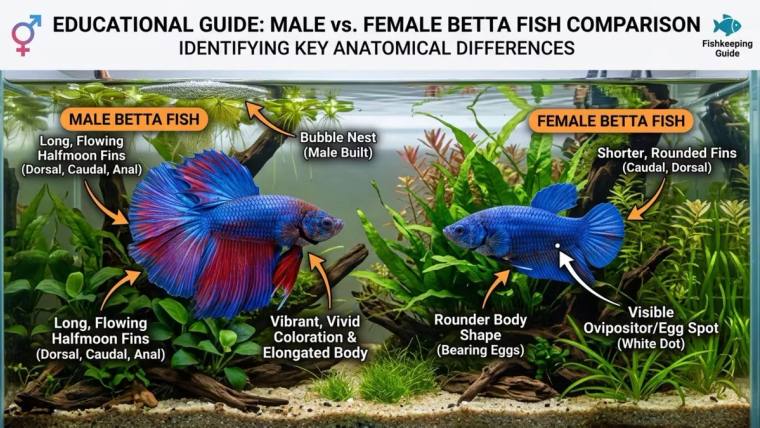
Most articles list three or four markers and call it done. The problem is that relying on just one or two features leads to errors, especially with certain betta varieties. Here are all seven markers you should check, along with how reliable each one actually is.[1]
| Physical Feature | Male Betta | Female Betta | Reliability |
|---|---|---|---|
| Egg spot (ovipositor) | Absent | Present (white dot near ventral fins) | Very High |
| Fin length | Long, flowing | Short, rounded | High (varies by variety) |
| Body shape | Slender, elongated | Rounder belly, wider | High |
| Color intensity | Vivid, iridescent | Duller base colors | Moderate |
| Beard (branchiostegal membrane) | Large, visible when flaring | Tiny, barely visible | High |
| Vertical spawning stripes | Absent | Present under stress or when gravid | Moderate (not always visible) |
| Bubble nest building | Males build nests | Females do not build nests | Moderate (rare exceptions exist) |
1. The Egg Spot (Ovipositor Tube): The Most Reliable Identifier
The ovipositor is a small white dot located between the ventral fins on the underside of the female's belly. It's the tube through which eggs are released during spawning. Males don't have one, period. If you see it, the fish is female.
It typically becomes visible at around 8 to 12 weeks of age. In juvenile fish younger than that, even this marker can be difficult to spot. To see it clearly, hold a small flashlight above the tank and look at the fish from below, or use a white background behind the tank to improve contrast.
Expert Note: The ovipositor is sometimes confused with a parasite or small injury by new keepers. A parasite typically looks irregular and may be attached at different angles. The ovipositor is consistently located between the ventral fins, perfectly centered, and white or cream in color.
2. Fin Length and Shape: Caudal, Dorsal, Anal, and Ventral Fins Compared
Male bettas have significantly longer and more elaborate fins. The caudal (tail) fin and anal fin are the most obvious, often spanning well beyond the body length. The dorsal fin on a male tends to run the full length of the back.
Female fins are shorter and more rounded. A useful trick is the "beard stripe" on the dorsal fin: females often show a subtle horizontal stripe along the dorsal fin edge that males don't have. This isn't always present, but when it is, it's a strong indicator.
Keep in mind that double tail bettas and halfmoon females can develop more elaborate fins than typical females, making this marker less reliable for fancy varieties. Always cross-check with the egg spot.
3. Body Shape and Size: Sexual Dimorphism Explained
Male bettas have a distinctly slender, streamlined body built for display and speed. Female bettas carry a noticeably rounder, wider profile, especially in the belly region. This difference becomes even more pronounced when a female is gravid (carrying eggs).[1]
In terms of size, males typically reach 2.5 to 3 inches in body length. Females are usually slightly smaller, though the difference isn't dramatic enough to use as a primary identifier on its own.
4. Color Intensity and Iridescence
Males are selectively bred for vivid, uniform, iridescent coloration because bright display colors help them attract females and intimidate rivals. Females generally show a duller base color, though many captive-bred females today carry surprisingly rich patterns and colors.
This is the least reliable marker of the seven. Color alone should never be used to determine sex. A brilliantly colored female can easily fool someone who's relying only on this one signal, and a stressed or ill male may look far duller than expected. Use color as a supporting clue, not a conclusion.
5. The Beard (Branchiostegal Membrane) Under the Gill Cover
When a betta flares, it spreads a membrane beneath its gill covers called the beard. On males, this membrane is large and dramatically visible during a threat display. On females, the membrane exists but is very small and almost impossible to see unless you're specifically looking for it.
To check this, gently hold a mirror in front of the tank for a few seconds. The betta should flare. If the membrane extending below the gill cover is prominent, you're almost certainly looking at a male.
6. Vertical Spawning Stripes: A Female-Specific Signal
Female bettas can develop vertical dark stripes running across their sides. These are called spawning stripes or breeding bars, and they appear when a female is ready to breed or experiencing stress. Males develop horizontal stress stripes instead, which is a key distinction.
These stripes aren't always visible, so their absence doesn't confirm male sex. But when vertical stripes appear on a betta you thought was male, that's a strong signal to reconsider.
7. Bubble Nest Building Behavior
Male bettas build bubble nests at the water surface, clusters of tiny air bubbles sometimes mixed with plant material. It's a paternal behavior tied to spawning readiness. A betta actively constructing a bubble nest is almost certainly male.
The word "almost" is important here. There are rare reports of female bettas building rudimentary nests, though this is uncommon. A bubble nest alongside no visible egg spot and long fins is a very strong indicator of male sex.
One thing to note: a cluster of surface foam caused by poor water quality or a protein buildup looks similar to a bubble nest. A real bubble nest is deliberate, usually built under a leaf or in a corner, and forms a tight cluster. Surface foam from water quality issues is more scattered and irregular. If you're unsure, check your water parameters first. Use an API Freshwater Master Test Kit and look for ammonia above 0 ppm, which is a common trigger for that kind of surface film.
How to Tell If a Betta Fish Is Male or Female: A Step-by-Step Identification Workflow
Running through all seven markers at once can feel overwhelming, especially if you're new to this. Use this sequence instead, starting with the most reliable indicators and working toward the supporting ones.
Step 1: Check the Underside for the Egg Spot First
Turn off the main tank light and use a small flashlight held above or to the side. Look at the underside of the fish near the ventral fins. A white dot between those fins confirms female. No dot means male, or a juvenile too young to confirm. This single check resolves most cases.
Step 2: Compare Fin Length to a Known Reference
Look at the caudal (tail) fin and the anal fin, the long fin running along the underside. On males, the anal fin is significantly longer and often has a pointed trailing edge. On females, it's shorter and more rounded. If you're unsure, compare the fin length to the body length. On most male bettas, the caudal fin alone equals or exceeds the body length.
Step 3: Assess Body Shape from Above and from the Side
Look at the fish from directly above. A wider midsection with a slightly rounded belly suggests female, especially if the rounding is in the abdominal area. From the side, a slender, uniform torpedo shape points toward male.
Step 4: Watch for Behavioral Cues Over 24 to 48 Hours
Observe the fish at different times of day. Does it build a bubble nest at the water surface? That points toward male. Does it show vertical stripes when another betta is nearby or when stressed? That points toward female. Behavior observed over time often confirms what the physical markers suggest.
When You Still Can't Tell: Age, Stress, and Variety Exceptions
Juveniles under 8 weeks old genuinely can't be sexed with confidence. The egg spot hasn't fully developed, and fins haven't reached their full expression. If you're buying from a store where all the fish are juveniles, accept that confirmation may need to wait a few more weeks.
Fancy varieties like halfmoon females, delta females, and rosetail females can develop surprisingly long fins that approach male appearance. In those cases, the egg spot check becomes even more important. And for double tail bettas specifically, body shape is a better guide than fin length due to the naturally enlarged double caudal fin in both sexes.
Male vs Female Betta Temperament and Behavior
The behavior difference between male and female bettas is real, but it's also often oversimplified. Understanding what's normal for each sex helps you read your fish accurately.[3]
Male Betta Aggression: What Is Normal Territorial Behavior
Male bettas flare at their own reflections, at other fish, and sometimes at objects in the tank that catch the light. This is normal display behavior and a sign of a healthy, confident fish. A few minutes of flaring per day is fine and even beneficial as mild exercise.
What isn't normal is constant flaring, color fading between displays, clamped fins, or refusal to eat. Those are stress signals, not confidence. If your male is flaring obsessively at something in the tank, check whether a decoration is creating a mirror effect, or whether another fish's movement is triggering him. Consistent stress raises cortisol levels and suppresses immunity, which can lead to betta fish diseases appearing over time.
One behavioral quirk worth knowing: bettas are intelligent enough to recognize their keepers and often display differently to humans than to other fish. A betta flaring at you is usually just reacting to movement near the glass, not aggression toward you specifically.
You may also notice your betta resting near the bottom or floating motionless near the surface at certain times of day. This is usually normal rest. Bettas do sleep, and they don't close their eyes when doing so, which can look alarming if you haven't seen it before.
Female Betta Temperament: Are Females Really Calmer?
The short answer is: sometimes, but not always. Female bettas are less prone to dramatic threat displays, but they are absolutely capable of aggression, particularly toward other females in the same space. The idea that female bettas are universally peaceful is one of the most persistent myths in the hobby.
Female-on-female fin nipping is common when tank conditions aren't right. It usually starts with one dominant female establishing a territory and targeting others. Tail damage, split fins, and stress hiding are the visible outcomes. This behavior doesn't mean the fish is broken, it means the setup needs adjustment. Female betta aggression is a real topic worth understanding before setting up a group tank.
Can Female Bettas Live Together? The Sorority Tank Truth
Yes, female bettas can live together under the right conditions. The problem is that those conditions are more specific than most guides admit, and a lot of sorority tanks fail within weeks of setup. Understanding why they fail is just as important as knowing how to set one up.
The Minimum Requirements for a Stable Female Betta Sorority
Tank size is not negotiable. A 20-gallon tank is the starting point, and larger is better. In smaller tanks, territory overlaps and there's simply no escape route for a fish being chased. Bettas need space to establish their own zones and break line of sight.
Group size matters equally. A group of three female bettas almost always results in two ganging up on one. Four to six females is the recommended minimum because aggression gets distributed more evenly across the group rather than focusing on a single target. Keeping multiple bettas together requires careful planning.
Dense planting and visual barriers are essential, not decorative. Live plants like Java Fern, Anubias, and Amazon Frogbit create natural territories and break sightlines between fish. An open, sparsely decorated tank is a recipe for constant chasing. Check out some betta fish aquarium ideas for planted setups that work well for sororities.
Water Parameters for a Sorority Tank: Temperature: 76 to 82°F (24 to 28°C). pH: 6.5 to 7.5. Ammonia: 0 ppm. Nitrite: 0 ppm. Nitrate: under 20 ppm. A cycled tank with a sponge filter and a reliable aquarium heater is the baseline. Test weekly with an API Freshwater Master Test Kit.
Keep an aquarium divider on hand before you need it. If a fish is being persistently targeted, quick separation is the most humane response. Waiting to see if things calm down often results in more fin damage.
How to Introduce Females to a Sorority Without Triggering a Fight
The simultaneous introduction method works far better than adding one fish at a time. Adding a single new female to an established group is one of the fastest ways to trigger sustained aggression, because the existing females have already claimed territories and the newcomer has no established position.
Before introducing the fish, rearrange all the tank decorations and plants. This resets territory boundaries for every fish in the tank and puts them all on equal footing. Then add all the females at the same time, ideally at the start of a period when you can observe the tank for a few hours. Expect some chasing and posturing in the first hour. What you're watching for is whether any single fish gets cornered repeatedly and has no ability to retreat. Read our guide on how to acclimate betta fish properly before introducing them to any new tank.
Warning Signs Your Sorority Is Failing: When to Separate
Some initial chasing is normal. Persistent targeting of one specific fish is not. Watch for a fish that refuses to come out and eat, hides constantly behind the same decoration, has fins that look progressively worse each day, or sits at the bottom with clamped fins.
When you identify a problem fish, isolate it first, even if it's the victim and not the aggressor. The aggressor may shift targets once the original victim is removed, or may calm down with one fewer competitor in the space. Then reevaluate whether the tank is large enough and whether the group dynamic is sustainable.
Watch Out: The "one bully" problem is common in sorority tanks. If one female is consistently targeting all the others despite a proper setup and adequate tank size, that individual fish may simply not be compatible with group living. Some bettas, male or female, are just more aggressive than others due to individual personality variation. Removing that fish is the right call.
Sorority Tank Failure Rate: Why Most Fail and How to Beat the Odds
The honest reality is that most betta sororities collapse within the first few months. The most common cause isn't aggression between random fish, it's the tank being too small, understocked, or underdeplanted. When fish can always see each other with no visual breaks and no space to retreat, tension escalates continuously.
The setups that succeed tend to have heavily planted tanks of 30 gallons or more, six or more females, driftwood and tall plants creating clear visual zones, and regular water changes keeping parameters stable. If you're set on a sorority, go bigger than you think you need and plant more than you think is necessary. Those two things alone dramatically improve the odds.
Can a Male and Female Betta Fish Live Together?
This is one of the most frequently asked questions in the hobby, and the honest answer is: not permanently. Most attempts at long-term male-female cohabitation end with a stressed, injured female, or worse.
The Short Answer: Permanent Cohabitation Is Not Recommended
Outside of an active spawning period, males pursue females aggressively. Even when no aggression is visible, the constant presence of a male puts a female under chronic stress. She's never fully at ease, and that stress takes a toll on her health over weeks and months.
The female can't signal submission in a way the male reliably accepts the way many other fish species can. The male simply continues to display and pursue. If you're keeping multiple bettas in the same space, a tank divider or separate tanks is the responsible setup.
The Only Time Males and Females Are Housed Together: Controlled Breeding
During a controlled breeding attempt, a male and female are introduced in a specific sequence designed to minimize injury risk. The female is placed in a breeding box or separated by a clear divider first, allowing the male to see her and begin building a bubble nest without direct access to her.
Once the male has an established bubble nest and both fish show interest, typically with the female displaying vertical spawning stripes and the male flaring and dancing without attacking, the divider is removed. The actual spawning process involves the male wrapping himself around the female in an embrace. Afterward, the female must be removed immediately. Post-spawning, males become highly protective of the eggs and will attack the female without hesitation.
Indian almond leaves are commonly used in betta breeding tanks. The tannins they release lower pH slightly and have mild antibacterial properties that benefit both the eggs and the fry. If you're setting up a breeding environment, they're worth including alongside the right betta fish tank setup.
Female bettas can also lay eggs without a male present, which surprises many keepers. These unfertilized eggs won't develop into fry, but seeing eggs in a tank with a solo female is perfectly normal.
Proper Tank Setup for Separate Male and Female Housing
Each betta, regardless of sex, needs its own tank of at least 5 gallons. A sponge filter keeps water clean without creating strong current, which bettas dislike. An aquarium heater is non-negotiable for tropical fish that require stable temperatures of 76 to 82°F. An aquarium thermometer helps you verify the heater is working accurately.
Live plants improve water quality and give bettas places to rest and explore. Java Fern and Anubias are both excellent beginner-friendly choices that thrive in betta tank conditions without requiring CO2 injection. Do bettas need a filter? Yes, and here's why even with a small tank it makes a significant difference to water quality and fish health.
Betta Sex Myths That Beginners Still Believe
Some of the most common advice you'll find online about sexing bettas is just wrong. These myths persist because they're partially true in some cases, which makes them feel reliable even when they're not.
Myth: Brightly Colored Bettas Are Always Male
This was more reliably true decades ago, when most captive females were drab. Today's captive breeding programs produce brilliantly colored females in nearly every variety. A vibrant red female halfmoon can easily be mistaken for a male based on color alone. Always check the egg spot. Betta fish color can also shift with age, health, and environment.
Myth: Females Never Flare or Show Aggression
Female bettas flare. They chase. They establish territory. They fin-nip. The aggression is generally lower-intensity than in males, but calling female bettas peaceful is inaccurate. Anyone who has watched a dominant female run a smaller female ragged in a sorority tank knows this firsthand.
Myth: A Bubble Nest Confirms the Fish Is Male
Almost always true, but not always. Some female bettas have been observed building rudimentary bubble structures, particularly in tanks with heavy surface agitation or after exposure to a male. Don't use bubble nest alone as your single confirmation. Cross-check with the egg spot and fin length.
Myth: Female Bettas Are Boring Compared to Males
Female bettas have personality. They're curious, responsive to their keepers, and capable of complex social behavior. Many experienced betta keepers strongly prefer keeping females precisely because their behavior is more nuanced and their care setup involves interesting group dynamics. A well-stocked sorority tank can be one of the most engaging displays in the hobby.
Myth: You Can Always Tell Sex at the Pet Store
Juvenile bettas are routinely mislabeled at pet stores, sometimes because staff aren't trained in betta sexing, sometimes because the fish genuinely aren't sexually mature enough to sex confidently. Always do your own visual check before making housing decisions, and if the fish is too young to confirm, plan for the possibility that the sex label may need revisiting in a few weeks.
Common Beginner Mistakes When Identifying Betta Sex
Even armed with the right information, new keepers fall into predictable patterns. Here are the errors that cause the most problems and how to avoid them.
Trying to Sex a Betta Under 8 Weeks Old
Patience is the only solution here. Before 8 to 12 weeks, the sexual markers simply haven't fully developed. Attempting to sex a very young fish leads to guesswork, and acting on that guesswork by placing fish together before you're sure can cause problems. If you're not certain of the age, err on the side of separate housing until the fish matures.
Relying on Color or Fin Length Alone
These are supporting indicators, not standalone answers. A fancy female variety with impressive fins will fool you if you skip the egg spot check. Always use at least two or three markers in combination, with the egg spot as the primary confirmation.
Confusing Stress Stripes with Spawning Stripes
Both types of stripes appear in females, but they look and mean different things. Spawning stripes are vertical, running from the dorsal area down toward the belly, and indicate breeding readiness. Stress stripes are horizontal, running along the length of the body, and indicate fear, illness, or environmental stress. A fish showing horizontal stress stripes may be dealing with poor water quality issues or social pressure from tank mates.
Trusting Pet Store Labeling Without Verification
Store labels are a starting point, not a guarantee. This is especially true for bettas in community display tanks where individual fish may not be examined closely by staff. Do your own check every time, regardless of what the label says.
When to Worry: Health Symptoms That Mimic Sex-Related Behaviors
A few health conditions look similar to normal sex-specific traits or behaviors. Getting confused between the two can delay treatment when a fish actually needs it.
A Distended Belly: Gravid Female vs Dropsy vs Constipation
A rounded belly in a female betta can mean she's gravid (carrying eggs), which is normal and harmless. It can also mean dropsy, a serious condition, or constipation from overfeeding.
The key difference is in the details. A gravid female looks evenly round in the abdominal area, is active, eating normally, and has good color. Dropsy causes the scales to lift away from the body, creating a "pinecone" appearance when viewed from above. The fish also typically becomes lethargic and loses color. Betta fish diseases like dropsy require immediate attention and possible antibiotic treatment. Constipation, by contrast, causes a firm, localized belly swelling and can often be resolved with a 24-hour fast or a small piece of daphnia.
If your betta is showing any combination of lethargy, pineconed scales, pale color, and reduced appetite, don't assume it's just a gravid female. Test your water first and check for swim bladder issues that can accompany these conditions.
When to Contact an Aquatic Vet: If a female's distended belly doesn't resolve within a week, if pineconing is visible, or if the fish stops eating entirely, consult an aquatic veterinarian. Dropsy is often secondary to an underlying bacterial infection and responds poorly to home treatment alone.
Unusual Aggression in a Normally Calm Fish: Disease or Sex-Related?
A sudden spike in aggression from a fish that was previously calm is worth investigating as a health signal, not just a personality change. Ammonia or nitrite spikes cause physical irritation and can make bettas far more reactive than usual. If your water parameters are off, the aggression often resolves once the tank stabilizes again.
Internal parasites can also cause restlessness and irritability. Symptoms alongside aggression to watch for include rubbing against decorations, white stringy feces, and rapid gill movement even when the fish is otherwise still. Test your water first with the API kit, then consider a treatment protocol if parameters are clear and symptoms persist. White spots on fins alongside irritability point toward ich, a parasitic infection requiring prompt treatment.
Once you know what to look for, identifying a betta's sex becomes second nature. The egg spot check alone resolves most questions in under a minute. Everything else, fins, body shape, behavior, is context that helps you understand your fish better. Whether you're setting up a sorority, planning a breeding project, or just confirming what you already bought, these markers give you reliable answers without guesswork.
References
- Panthum, T. et al. (2022). "Something Fishy about Siamese Fighting Fish (Betta splendens) Sex: Polygenic Sex Determination or a Newly Emerged Sex-Determining Region?" MDPI Genes. https://pmc.ncbi.nlm.nih.gov/articles/PMC9179492/
- Forsatkar, M.N. et al. (2017). "Timing of isolation from an enriched environment determines the level of aggressive behavior and sexual maturity in Siamese fighting fish (Betta splendens)." PMC / NCBI. https://www.ncbi.nlm.nih.gov/pmc/articles/PMC10127351/
- Huang, Z. et al. (2018). "De novo transcriptomic characterization of Betta splendens for identifying sex-biased genes." bioRxiv. https://www.biorxiv.org/content/10.1101/355354.full.pdf
- Aquarium Co-Op Community. "What causes betta sororities to fail?" Aquarium Co-Op Forum. https://forum.aquariumcoop.com/topic/3066-what-causes-betta-sororities-to-fail/