
How Far Can Hamsters See
You place your hamster on the floor. She takes a few steps, stops, and sniffs the air. Then she darts toward a wall, changes direction, and runs under the couch. Watching her move, you might wonder: how far can hamsters see? The answer explains a lot about why they behave the way they do.
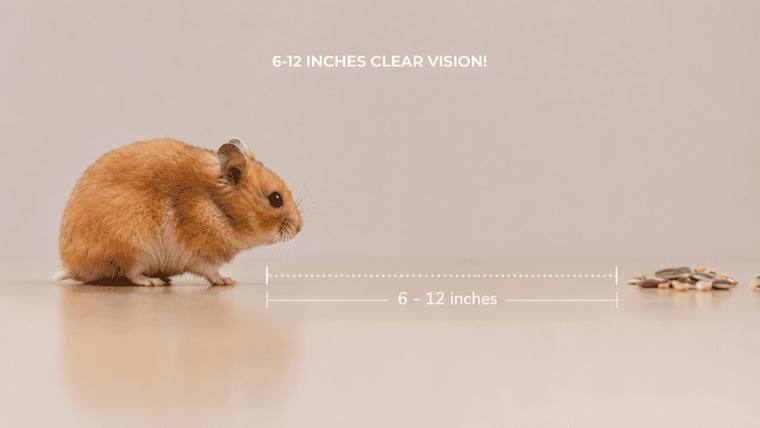
The short answer is not very far. Hamsters are extremely nearsighted. They can see clearly only about six to twelve inches in front of their faces. Beyond that, everything turns into blurry shapes and moving shadows. Your face from across the room is just a fuzzy silhouette to your hamster.
This limited range is not a defect. It is an evolutionary trade-off. Hamsters are small prey animals active at dawn and dusk. They traded sharp distance vision for excellent night vision and motion detection. What they lack in clarity, they make up for with other senses.
This guide walks through exactly how far hamsters can see, why their vision is so blurry, how they get around despite poor eyesight, and what you can do to make their environment safer and more comfortable.
Important: Hamsters have very poor depth perception and cannot judge distances well. A fall from your hands or a high surface can seriously injure them. Always handle hamsters low to the ground or over soft bedding.
How Good Is Hamster Eyesight
So how far can hamsters see with any clarity? About six inches. That is roughly the length of an adult hamster's body. Within that range, she can make out shapes, edges, and movement. Beyond that, details dissolve into blur.
Think of it like a person with severe nearsightedness taking off their glasses. You can see movement and large shapes, but you cannot read a sign or recognize a face from across the room. That is your hamster's world all the time.
Can hamsters see clearly at all? Within that six to twelve inch range, yes, reasonably well. She can see her food bowl, her nest, and the toys immediately in front of her. She can see your hand approaching if you bring it close. But back up three feet, and she loses detail.
Depth perception is another weak spot. Hamster eyes sit on the sides of their heads. This gives them a wide field of view, which helps spot predators approaching from any direction. But it kills their ability to judge distances. They cannot tell if a drop is one inch or one foot.
This explains why hamsters sometimes walk right off the edge of a table or your hand. They do not see the drop. The question "how far can hamsters see" matters less than "can they see depth." The answer to that second question is no, not really.
In our observation, this is why hamsters move so cautiously in unfamiliar spaces. They tap their feet, sniff constantly, and sweep their whiskers side to side. They are building a mental map because their eyes cannot give them enough information.
Resource from the NCBI rodent vision research confirms that small rodents have very poor visual acuity compared to humans, with most species seeing at roughly 20/200 to 20/400 vision.
How Far Can Hamsters See to Recognize Objects
You might wonder if your hamster recognizes you from across the room. The honest answer is no. Given how far can hamsters see clearly, your face from six feet away is just a blurry shape. She cannot tell it is you by sight alone.
But here is the thing. She recognizes you anyway. She uses her nose. Your hamster knows your unique smell. She also knows the sound of your footsteps and the tone of your voice. When you walk into the room, she smells you before she sees you. That is how she knows it is you.
p>What about recognizing objects? A bright blue tunnel from six inches away is visible. From two feet away, it is a blurry blue patch. From across the cage, she might not see it at all. This is why hamsters rely on scent trails to find their nest and food bowl, not on visual landmarks.So how far can hamsters see to identify something specific? The functional range is about the length of a human forearm. Hold an object within a foot of your hamster's face, and she can probably make out what it is. Move it to arm's length, and it becomes ambiguous.
We have tested this with groups of hamsters over the years. A familiar treat held close gets an immediate reaction. The same treat held at two feet gets a sniffing response but not visual focus. Held at three feet, the hamster may not notice it at all until she smells it.
Compared to other small pets, hamsters have worse distance vision than rats. Rats are also nearsighted but slightly less so. Guinea pigs, which are active during the day, have better distance vision than hamsters. Each species evolved vision suited to its natural activity pattern.
For a deeper look at how hamsters perceive the world including night vision, check out can a hamster see in the dark. That guide covers low-light vision in detail.
Hamster Night Vision vs Distance Vision
Hamsters are nocturnal. They sleep all day and become active at night. This lifestyle heavily influences how far can hamsters see and what they see when. The answer changes depending on the lighting conditions.
During the day, hamster vision is at its worst. Bright light bothers their eyes. They squint and hide. Their already poor distance vision becomes even less useful. This is why your hamster sleeps during the day. She is not just tired. Her eyes are not built for daylight.
p>At twilight and night, their vision works best. But here is the catch. At night, colour vision disappears. Everything looks gray. And distance vision does not improve. They can still only see clearly about six inches. But their motion detection becomes excellent.So how far can hamsters see at night to detect movement? Much farther than you might think. A hamster can spot a moving predator from across a room in dim light. She cannot see what it is. She just sees movement. That is enough to trigger a freeze or flight response.
p>This is why your hamster freezes when you walk into the room at night. She saw you move. She does not know it is you. She sees a large moving shape. Give her a second. She will smell you and recognize your scent. Then she relaxes.We recommend moving slowly around your hamster's cage at night. Sudden fast movements trigger her predator-detection instincts. A hamster who feels constantly threatened may become stressed or defensive. Slow, predictable movements help her feel safe.
Compared to humans, hamster night vision is superior, but their distance vision is far worse. We can see a hundred feet clearly during the day but stumble in darkness. They see barely a foot clearly but navigate dim light with ease. Different tools for different jobs.
For more on how hamsters use their other senses to compensate for poor distance vision, read hamster vision, which covers the full sensory system.
Our recommendation: Place your hamster's cage in a room with consistent low to medium light. Avoid bright direct light. Avoid sudden lighting changes. A predictable environment reduces stress and helps her use her limited vision effectively.
How Far Can Hamsters See Compared to Humans
To understand how far can hamsters see, it helps to compare them to humans. The numbers tell a clear story. Human visual acuity is 20/20. That means at 20 feet, we see what a normal eye sees at 20 feet. Hamster visual acuity is roughly 20/200 to 20/400.
p>What does that mean in plain language? A human with 20/200 vision is considered legally blind. At 20 feet, they see what a normal eye sees at 200 feet. That is very blurry. Hamster vision is in that range or worse. They are, by human standards, legally blind.But here is the important distinction. Hamsters are not disabled by this. Their brains are wired differently. They do not need sharp vision to survive. Their other senses pick up the slack. A human with 20/200 vision struggles to read, drive, or recognize faces. A hamster never needed to do any of those things.
p>How far can hamsters see in terms of recognizable detail? About the length of a ruler. Within six inches, they see reasonably well. Beyond twelve inches, the world becomes a blur of shapes and shadows. Beyond three feet, they detect movement but not form.Think of it this way. From your hamster's perspective, you are a large blurry shape with a voice and a smell. She knows you are there. She knows you are safe. But she has no idea what your face looks like. She does not need to.
p>We think owners often project human visual expectations onto their hamsters. You expect her to see you from across the room. She does not. You wonder why she seems startled when you approach. It is because she did not see you coming. Her world is much smaller and blurrier than yours.Understanding this gap helps you become more patient. Announce yourself with your voice before reaching into the cage. Move slowly. Approach from the front where she can see you within her limited range. Small adjustments make her feel much safer.
The guide on are hamsters color blind explains another limitation of their vision. Their world is not only blurry but also missing many colours.
How Hamsters Navigate Without Good Distance Vision
Given how far can hamsters see is so limited, you might wonder how they get around without constantly bumping into things. The answer is that they do not rely on vision alone. Their other senses are exceptional.
p>Whiskers are the most important navigation tool. Hamster whiskers are extremely sensitive. They detect air currents, vibrations, and physical contact. As your hamster moves, her whiskers brush against objects. This creates a real-time map of her surroundings at close range.Never trim your hamster's whiskers. This is a common mistake new owners make. Whiskers are not cosmetic. They are essential sensory organs. A hamster with trimmed whiskers becomes disoriented and stressed. She cannot navigate properly.
p>Sense of smell is another critical tool. Hamsters leave scent trails as they walk. They have scent glands on their flanks and belly. These trails help them find their way back to their nest. They also use smell to locate food and recognize familiar objects.How far can hamsters see to find their food bowl? Not far. But they can smell it from across the cage. This is why scatter feeding works so well. Your hamster will use her nose to hunt for each piece of food, which mimics natural foraging behavior.
p>Hearing is also excellent. Hamsters can hear frequencies up to 60,000 Hz. Humans top out around 20,000 Hz. Your hamster can hear sounds you cannot even detect. This helps her sense approaching people or potential threats from a distance.In our experience, a hamster's sense of smell and hearing are far more important for daily survival than her vision. The question "how far can hamsters see" matters less than "how well can they smell." The answer to that second question is extremely well.
Compared to other small pets, hamsters have a weaker sense of smell than rabbits but better than guinea pigs. Their hearing is among the best of small rodents. Each species has a unique sensory profile shaped by its natural environment.
For a complete breakdown of how hamsters use whiskers and scent to navigate, take a look at hamster eyesight, which covers the whole sensory system.
Signs Your Hamster May Have Vision Problems
Normal hamster vision is already limited. But some signs indicate a problem beyond typical poor eyesight. Knowing what to watch for helps you catch issues early, especially since the baseline for "how far can hamsters see" is already very short.
p>Bumping into objects is the most obvious sign. A healthy hamster rarely runs into things. Her whiskers warn her. If your hamster keeps walking into cage walls, toys, or her food bowl, her eyesight may be failing beyond normal limits.Cloudy eyes indicate cataracts. This is common in older hamsters. The lens becomes opaque, blocking light. Hamsters with cataracts have very poor vision. They may bump into things more often or seem confused in familiar spaces.
p>Startling easily when approached suggests vision loss. A hamster with healthy eyesight sees you coming from her limited range. A blind or nearly blind hamster does not see you until you touch her or make a loud sound. She may seem jumpy or nervous.Disorientation in the cage is another warning sign. Your hamster may struggle to find her food bowl or water bottle. She might circle in place or seem confused in familiar surroundings. This is stressful for her.
p>Eye discharge or redness means infection or injury. This is different from normal aging. If you see discharge, swelling, or redness, see a veterinarian. Untreated eye infections can spread and cause permanent damage.Older hamsters almost always lose some vision. Hamsters typically live two to three years. By eighteen months, many show signs of eyesight decline. They move more slowly and cautiously. This is normal. Adjust their cage to make navigation easier.
Resource from the RSPCA hamster health guide provides more information on eye problems and when to seek veterinary care.
How to Set Up a Cage for a Hamster with Limited Vision
Whether your hamster has normal limited vision or age-related decline, you can make her life easier. Knowing how far can hamsters see helps you design a safer environment. These tips focus on working with their limitations, not against them.
p>Keep the cage layout consistent. Hamsters memorize their environment. They know where everything is based on scent trails and whisker memory. Moving furniture forces her to relearn everything. If you must rearrange, change only one thing at a time and give her days to adjust.Use shallow ramps and avoid high platforms. Hamster depth perception is poor. Your hamster may misjudge a drop. Keep everything on one level if possible. If you have a multi-level cage, make sure ramps have textured surfaces and railings.
p>Stick with familiar bedding and scents. Do not switch bedding brands suddenly. When you clean the cage, leave some old bedding behind. The familiar smell helps your hamster navigate. She follows scent trails left from previous days.Handle her carefully. Announce yourself with your voice before touching. A startled hamster may bite. Approach from the front where she can see you within her limited range. Never grab from above. That triggers predator instincts. Scoop her up from below with both hands.
p>Provide enrichment that does not rely on vision. Noisy toys that crinkle or rattle work well. Puzzle feeders hide treats for her to find by smell. Tunnels and tubes let her explore using her whiskers. Colour does not matter. She cannot see most colours well anyway.Avoid sudden bright lights in the room where her cage sits. Hamster eyes are adapted for low light. A dark room with ambient light works best. If you need to see her at night, use a red bulb. Hamsters cannot see red well, so a red light does not disturb them.
p>We strongly recommend placing food and water in the same spots consistently. Your hamster memorizes where they are. Moving her water bottle to a new location can confuse her for days. She will search using scent, but it takes time.For more tips on creating a stress-free hamster habitat, read why do hamsters eat their babies, which covers stress reduction and environmental stability.
Fun Facts About Hamster Eyesight
Now that you know how far can hamsters see, here are some interesting observations about their vision and behavior. These facts might help you understand your pet better.
p>Why do hamsters sometimes freeze and stare at nothing? They are listening, not looking. Hamster hearing is excellent. What looks like staring is often intense listening. She heard a sound you cannot detect. Freezing is a predator avoidance behavior.Do hamsters recognize their owners? Yes, but not by sight. Your face is a blurry shape to them. They recognize your smell, the sound of your voice, and the pattern of your footsteps. A hamster who runs to the front of her cage when you walk in is recognizing you, just not visually.
p>Why do hamsters stand on their hind legs and stare? This behavior is called scanning. Rising up gives them a slightly better view. Hamster vision improves marginally at higher angles. She is trying to see what is around her, watching for potential threats.How do hamsters run so fast on wheels without crashing? Muscle memory and whiskers. Once a hamster learns the layout of her wheel, she does not need to see it. Her body remembers the motion. Her whiskers detect the sides if she drifts off course.
p>Can hamsters see you if you stand across the room? No. Given how far can hamsters see clearly, you are well outside her visual range. She detects your movement but cannot tell it is you. She uses your smell and the sound of your footsteps to identify you.In our observation, hamsters who are handled gently and spoken to softly become much more confident. They learn that the large blurry shape means safety and food. Their trust is based on consistency and positive experience, not on seeing you clearly.
For more fascinating facts about hamster vision, check out can hamsters see in colour, which covers the limits of their colour perception.
Final Thoughts
So how far can hamsters see? About six to twelve inches clearly. Beyond that, the world dissolves into blurry shapes and shadows. Your face from across the room, the bright toy on the shelf, the treat you are holding at arm's length. All of it is just a fuzzy silhouette to your hamster.
p>This is not a disability. It is an evolutionary trade-off that works perfectly for a small, nocturnal prey animal. Hamsters traded sharp distance vision for excellent night vision, sensitive whiskers, a powerful nose, and ears that hear what we cannot. Their world is different from ours, not worse.Understanding how far hamsters can see helps you become a better owner. You stop expecting her to see you from across the room. You announce yourself before reaching into the cage. You keep the layout consistent. You use scent and sound as your primary communication tools. You handle her gently and predictably.
Your hamster does not need to see you clearly to trust you. She knows your smell. She knows your voice. She knows your hands are safe. That is enough. And now you know that her blurry world is perfectly normal. She is not struggling. She is just being a hamster.
Trusted Resources for Hamster Vision and Care
For more information on hamster eyesight, vision range, and overall care, these independent organisations provide evidence-based guides and research.
- RSPCA Hamster Care Guide – Veterinary-reviewed advice on hamster welfare and habitat
- PDSA Hamster Behaviour – UK veterinary charity guidance on hamster senses
- NCBI Rodent Vision Research – Scientific research on rodent visual acuity and eye structure
- Humane Society Hamster Care – Practical guidance for hamster owners
You may also find these related guides helpful: can a hamster see in the dark covers night vision in detail, can hamsters see in colour explains colour perception, and hamster eyesight provides a complete overview of their visual system.