The single biggest reason new bearded dragon owners run into health problems isn't the tank, the lighting, or even the vet bills. It's the bowl. Get the diet wrong and you'll see it in dull skin, weak bones, sluggish behaviour, and a beardie who just doesn't seem to be thriving. Get it right and you've got the kind of dragon that lives 10, 12, sometimes 15 years.
The tricky bit is that the "right" diet keeps shifting on you. What you feed a tiny hatchling is almost the opposite of what you feed a chunky adult. Insects vs. greens, daily vs. a few times a week, dusted with calcium vs. not - none of it is fixed, and honestly, most generic guides don't tell you why the rules change.
So that's what this is. A full diet guide that starts with the basics, walks you through each life stage, gives you actual lists of what's safe and what isn't, covers supplements properly, and finishes with a weekly meal plan you can adapt to your own beardie. No filler.
One quick note before you scroll: this is general guidance built from veterinary sources and experienced keepers. Your individual dragon - especially if they're picky, recovering from illness, gravid, or have a known health condition - will need a vet to weigh in. A reptile vet, ideally. Not just any vet.
Bearded Dragon Diet at a Glance
Bearded dragons are omnivores. That word does a lot of heavy lifting because it means their diet is genuinely split between two very different food groups: live insects (protein, fat, the muscle-building stuff) and plants (leafy greens, vegetables, the occasional fruit). The proportions of each shift as your dragon grows up.
Here's the short version most keepers go by:
- Baby (0–4 months): Roughly 70–80% insects, 20–30% plants. Fast growth, high protein demand.
- Juvenile (4–18 months): Slowly tilting toward plants. Around 50/50 by the middle of this stage, drifting toward 40/60 plant-heavy by 18 months.
- Adult (18+ months): Flip the ratio entirely. About 80% plants, 20% insects. Adults eating like babies get fat fast and tend to develop fatty liver disease.
That ratio shift is the single most important thing to internalise. A two-year-old dragon eating ten crickets a day is heading for a vet visit. A four-month-old dragon being offered a salad and not much else is going to be malnourished.
What Baby Bearded Dragons Eat (0–4 Months)
Babies are tiny eating machines. They're growing at a pace that's frankly absurd - quadrupling in size in their first few months - and that means protein, protein, protein.
Frequency: Feed insects 2–3 times a day, for about 10–15 minutes each time. Don't leave loose crickets in the tank after - they'll stress your dragon out and may nibble on them at night.
How many insects? A baby can eat 20–60 small insects a day. That number sounds wild but it's normal. Use small crickets (sized to fit between your dragon's eyes - never bigger, or you risk impaction) or small dubia roaches.
Greens: Yes, offer them. A small plate of finely chopped greens left in the tank for them to nibble at their leisure. Many babies will ignore them and that's normal - but keep offering, because if they don't see greens early, you'll have a juvenile in six months who refuses to touch anything green. Build the habit now.
Calcium: Dust their insects with calcium powder almost every feeding. More on supplements further down - it's worth its own section.
Juvenile Diet (4–18 Months)
This is the transitional stage. Your beardie is still growing but the breakneck pace is over. You're going to gradually shift them away from being insect-heavy.
Frequency: Insects once or twice a day at first, then dropping down to once a day, then to every other day as they approach the 12–18 month mark. Greens should be offered every single day.
Insect quantity: Around 25–50 insects across the day for younger juveniles, dropping as they grow. By 12 months, you should be at maybe 10–20 insects total per feeding, and not every day.
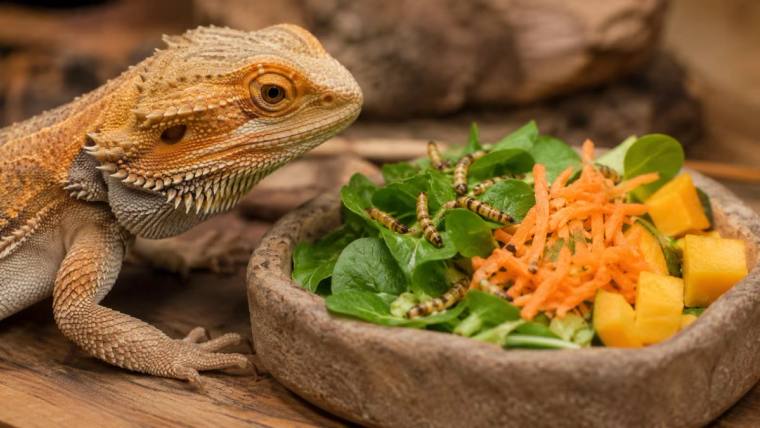
Greens: This is where you really push the salad. Variety matters. If you're rotating spring mix, collards, mustard greens, butternut squash, and a sprinkle of bell pepper week to week, you're doing well. Most pickiness happens at this stage and the only fix is consistency - keep offering, even when they snub it.
Fruit: Tiny amounts as a treat. Not daily. A couple of blueberries or a small piece of melon once or twice a week is plenty. Fruit is sugary and bearded dragons don't process it well.
Adult Bearded Dragon Diet (18+ Months)
Adult dragons are mostly plant-eaters, full stop. This is the bit that most owners get wrong because they associate "lots of insects" with "happy dragon," when actually, for an adult, the opposite is true.
Frequency: Fresh salad every day. Insects only 2–3 times a week. Some keepers go even lower, to once or twice a week, especially if their dragon is putting on weight.
Insect quantity: 10–20 medium insects per feeding session. That's it. Adult dragons eating insects daily almost always become overweight, and obesity in beardies leads directly to fatty liver disease - which is a major killer.
Greens: A generous salad bowl daily. Aim to leave it in for around 30 minutes, then take it out so it doesn't dry out or grow mould.
One day off: Many experienced keepers give adult dragons one no-food day per week. It mimics the irregular feeding they'd have in the wild and seems to help digestion. Water should always be available.
Safe Vegetables (The Daily Staples)
This is the heart of the adult bearded dragon diet, and the part you should genuinely build a habit around. Mix and match - variety is the goal, not finding one perfect green.
Daily / staple greens:
- Collard greens
- Mustard greens
- Turnip greens
- Dandelion greens (yes, the ones in your garden, as long as no pesticides have been used)
- Endive and escarole
- Cactus pads (prickly pear, de-spined)
Several times a week:
- Bell peppers (any colour)
- Butternut and acorn squash
- Green beans
- Carrots (chopped or shredded - high in vitamin A, so don't overdo)
- Sweet potato (cooked or raw, shredded)
- Sugar snap peas
Occasionally / weekly:
- Kale (high in oxalates that bind calcium - fine in rotation, bad as a daily staple)
- Broccoli (small amounts, can affect thyroid in larger quantities)
- Spinach (very high in oxalates - best avoided, or no more than a tiny pinch occasionally)
- Cabbage (small amounts)
- Cucumber (mostly water - fine as an occasional hydration treat)
If you take one thing from this list, let it be this: build your beardie's salad bowl around the staples (collards, mustard, turnip, dandelion) and rotate in the others as toppings. Don't just dump kale and spinach in there and call it done.
Safe Fruits (Treat-Only)
Fruit is for special occasions. Honestly. It's sweet, bearded dragons love it, and that's exactly why you have to ration it. Too much fruit causes diarrhoea, tooth decay, and weight gain - and beardies will absolutely fill up on fruit and refuse greens if you let them.
Safe fruits, offered no more than once or twice a week in small amounts:
- Blueberries (the easiest go-to)
- Strawberries (chopped, leaves removed)
- Raspberries
- Watermelon (seeds removed)
- Cantaloupe and honeydew melon
- Mango (small pieces, no skin)
- Papaya
- Apple (peeled, no seeds, no core - seeds contain trace cyanide)
- Pear (peeled)
Fruits to skip or be careful with: citrus fruits (too acidic, can cause stomach upset), avocado (toxic), rhubarb (toxic), and any fruit pits or stones.
Safe Insects & Live Food
Live insects aren't optional, they're essential, especially for younger dragons. But not all insects are created equal, and some shop-bought options that look convenient are actually poor staples.
Staple feeder insects (good for everyday use):
- Dubia roaches - high protein, low fat, easy to digest, low chitin. Most experienced keepers consider these the gold standard.
- Crickets - classic, widely available, decent nutrition. Just noisy and they smell. Make sure they're gut-loaded.
- Black soldier fly larvae (BSFL / Calci-worms / Phoenix worms) - naturally very high in calcium, so you can skip dusting these.
- Locusts - great for variety, high protein.
Occasional treats (high fat - don't overuse):
- Mealworms - hard exoskeleton, risk of impaction in young dragons. Adults only, and not as a staple.
- Superworms - even more fat than mealworms. Occasional only, and not for babies.
- Waxworms - basically reptile candy. High fat, very palatable. Use sparingly, mainly to coax sick or recovering dragons to eat.
- Silkworms and hornworms - excellent nutrition, soft bodies, good for variety. A bit pricey.
What to avoid completely: wild-caught insects (parasites and pesticides), fireflies (toxic - can kill a beardie), and any bug you found in your garden.
Gut-loading matters: "Gut-loading" means feeding your feeder insects nutritious food for 24–48 hours before they become dinner. A cricket that's been fed nothing but corn flakes is empty calories. A cricket that's been eating leafy greens, carrots, and proper gut-load powder is a nutritional powerhouse.
Foods to NEVER Feed Your Bearded Dragon
Some of these are genuinely dangerous. Some are just slow-burn problems. Either way, the list below should never end up in your dragon's bowl.
- Avocado - toxic to bearded dragons. Even small amounts can be fatal.
- Rhubarb - toxic. Skip entirely.
- Onion, garlic, chives, leeks - too acidic, can cause serious digestive issues.
- Wild-caught insects - parasites, pesticides, unknown bacteria.
- Fireflies / lightning bugs - actively toxic. Can kill.
- Iceberg lettuce - not toxic but offers zero nutrition and causes diarrhoea.
- Mushrooms - many varieties are toxic to reptiles.
- Citrus fruits - orange, lemon, lime, grapefruit. Far too acidic.
- Beet tops in large amounts - very high in oxalates.
- Dairy - bearded dragons are lactose intolerant. No cheese, milk, yoghurt.
- Meat from your kitchen - beef, chicken, pork. Bearded dragons can't process the fat content.
- Bread, pasta, processed food - none of it. Their digestive system isn't built for it.
Supplements: Calcium, D3 & Multivitamins
This is the bit that confuses most owners, partly because every source online tells you something slightly different. Here's the version that's worked well across most veterinary recommendations, with one rule that genuinely matters: your dragon needs proper UVB lighting for any of this to work. Without UVB, no amount of calcium will be absorbed, and you'll end up with metabolic bone disease (MBD) - one of the most common, and most preventable, illnesses in pet beardies.
What you'll need:
- Calcium powder without D3 (for most days)
- Calcium powder with D3 (for 1–2 days a week)
- A reptile multivitamin (with beta-carotene, not pure vitamin A - beardies can overdose on vitamin A)
Dusting schedule for babies (0–4 months):
- Calcium (no D3): 4–5 times per week
- Calcium with D3: 1–2 times per week
- Multivitamin: 1–2 times per week
Dusting schedule for juveniles (4–18 months):
- Calcium (no D3): 3–4 times per week
- Calcium with D3: 1–2 times per week
- Multivitamin: 1 time per week
Dusting schedule for adults (18+ months):
- Calcium: 2–3 times per week
- Calcium with D3: 1 time per week (or skip if using a strong mercury vapour bulb)
- Multivitamin: 1 time per week
How to dust: drop your feeder insects into a small container with a pinch of powder, shake gently so they get a light coating. They should look dusty, not buried - think powdered sugar dusting, not a sugar coating. Feed immediately so the powder doesn't fall off.
Skip dusting when feeding naturally calcium-rich insects like BSFL/Phoenix worms - they don't need it.
Sample Weekly Meal Plan
Here's what a balanced week could look like for a healthy adult bearded dragon. Adjust portions and quantities based on your individual dragon's appetite and weight.
Monday: Fresh salad of collard greens, shredded butternut squash, a few chopped bell pepper strips. 10–12 dubia roaches dusted with plain calcium.
Tuesday: Fresh salad of mustard greens, shredded carrot, a small sprinkle of blueberries on top. No insects today.
Wednesday: Fresh salad of turnip greens, chopped green beans. 10–12 crickets dusted with calcium + D3.
Thursday: Fresh salad of dandelion greens, endive, a small cube of mango as a topper. No insects.
Friday: Fresh salad of spring mix (no spinach), sugar snap peas. 10 dubia roaches dusted with plain calcium and a light dusting of multivitamin.
Saturday: Fresh salad of collard greens, shredded squash. No insects.
Sunday: No food day. Fresh water always available.
This is a guide, not gospel. If your dragon's losing weight, add an insect day. If they're putting on weight, cut one. Watch their body, not the calendar.
References
This guide pulls from veterinary sources and experienced keepers. For deeper reading:
- Arizona Exotic Animal Hospital - Bearded Dragon Nutrition (azeah.com)
- Falls Road Animal Hospital - The Bearded Dragon's Diet: What Can They Eat? (fallsroad.com)
- Dragon's Diet - The Complete Bearded Dragon Diet Plan (dragonsdiet.com)
- Northampton Reptile Centre - What Do Bearded Dragons Eat? Diet Guide & Safe Food List (reptilecentre.com)
- Reptile.Guide - How Much Dusted Calcium Bearded Dragons Need at Any Age (reptile.guide)
For health concerns specific to your bearded dragon - especially anything related to weight, refusal to eat, suspected MBD, or pregnancy - please consult a qualified reptile veterinarian.