
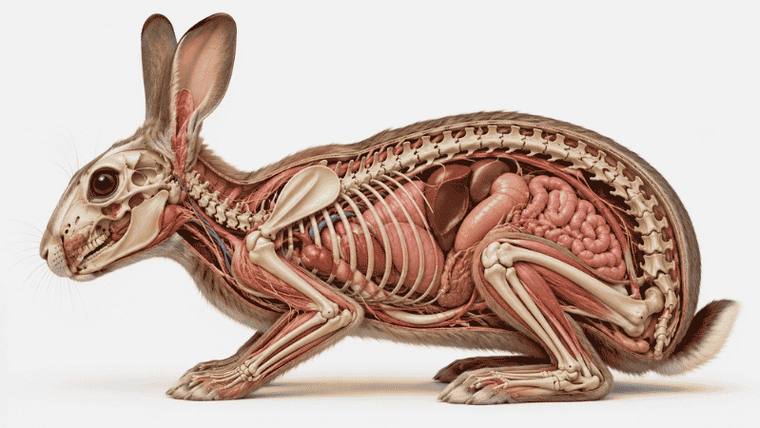
Rabbits look soft, calm, and straightforward from the outside. But underneath that fur is a body that is genuinely remarkable built for speed, camouflage, and near-constant digestion. Understanding the anatomy of a rabbit is not just interesting from a biological standpoint. For anyone who owns or cares for a rabbit, it is genuinely useful knowledge that can help you spot problems early, understand their behaviour, and keep them healthier for longer.
Most people are surprised to learn just how delicate a rabbit's body actually is. Their bones are lightweight and can fracture more easily than you might expect. Their digestive system is surprisingly fragile and needs to keep moving at all times. Their hind legs are so powerful relative to their frame that a single kick can cause a spinal injury if a rabbit is handled incorrectly. These are not abstract facts; they are things rabbit owners encounter in real life.
This article goes through the full rabbit body from skeleton to organs, covering what each part does, why it matters, and what can go wrong. Whether you are new to rabbit ownership or have kept rabbits for years, there is likely something here that will change how you see these animals.
The Rabbit Skeletal System
A rabbit is a vertebrate, meaning it has a backbone made up of individual vertebrae. The rabbit skeletal system is light, fine, and adapted for fast movement rather than strength or durability. An adult rabbit typically has around 212 bones, though the exact number can vary slightly between individuals and breeds. To put that in perspective, humans have 206 bones; so a much smaller animal has a comparable number, which tells you something about how fine and numerous those bones are.
The spine runs from the skull down to the tail and is divided into five regions: cervical (neck), thoracic (chest), lumbar (lower back), sacral (pelvis), and caudal (tail). Rabbits do have backbones and vertebrae, and their lumbar region; the lower back; is particularly important. This is where most spinal injuries occur, because the powerful hind leg muscles can exert enormous force on that relatively delicate area of the spine. A rabbit that panics while being held and kicks out hard can fracture or dislocate a lumbar vertebra in seconds.
The rib cage protects the heart and lungs and is made up of 12 to 13 pairs of ribs. The rabbit skull is long and narrow with large eye sockets positioned on the sides of the head, which gives rabbits a wide field of vision; an adaptation we will come back to later. The bones throughout the body are structured to be as light as possible, which is exactly why they break more easily than you might expect from an animal that looks sturdy.
The ratio of muscle mass to bone mass in a rabbit is unusually high. Their muscles are heavy relative to their skeleton. This is the core reason that mishandling is dangerous; the muscles are strong enough to generate force that the skeleton cannot always absorb safely.
Body Parts of a Rabbit
Starting from the outside, a rabbit's body is covered in dense fur that varies in texture and length depending on breed. Beneath the surface, each external feature has a specific function that connects directly to how rabbits survive in the wild.
The ears are one of the most recognisable features. In most breeds they are long, upright, and independently mobile, able to rotate and track sounds from different directions without the rabbit moving its head. The large surface area also helps with thermoregulation; blood vessels close to the skin surface release heat when the rabbit is warm. Lop-eared breeds have folded ears that limit both functions, which is part of why they can be more prone to ear infections and heat sensitivity.
Rabbit eyes are large and positioned on the sides of the head rather than facing forward. This gives them a field of vision of nearly 360 degrees, with only a small blind spot directly in front of their nose and behind their head. They can see predators approaching from almost any direction without turning around. However, their depth perception directly ahead is limited, which is why rabbits often tilt their head slightly when examining something close up.
The whiskers extend from either side of the muzzle and from above the eyes. They are sensory organs that help the rabbit judge whether a space is wide enough to pass through, and they are sensitive to air movement, which can signal nearby movement in low-light conditions.
The tail; the small round puff most people notice; is called a scut. It is white on the underside, and when a rabbit runs from a predator, the white flash is thought to confuse the predator's focus and potentially signal to other rabbits nearby.
Rabbit Legs and Feet
The legs are where rabbit anatomy becomes particularly impressive. Rabbits are digitigrade animals, meaning they walk on their toes rather than the flat of their foot. The hind legs are significantly longer and more muscular than the front legs, and this asymmetry is the reason rabbits can accelerate so quickly from a standing position.
The rabbit leg bones in the hind limbs include the femur (thigh bone), tibia and fibula (lower leg), and a series of long metatarsal bones that act almost like an extension of the leg, giving each stride extra length. This arrangement works like a compressed spring; the muscles and tendons store energy and release it explosively. Some rabbit species can reach speeds of over 55 kilometres per hour in short bursts.
Rabbit paw anatomy is worth understanding if you keep rabbits on hard or slippery floors. Unlike cats and dogs, rabbits have no paw pads in the traditional sense. The underside of their feet is covered in dense fur rather than thick skin pads. This gives them good grip on natural surfaces like soil and grass but very poor grip on smooth floors, which can lead to a condition called sore hocks; where the fur wears away and the skin becomes irritated or infected.
The claws are non-retractable and grow continuously. They need regular trimming in pet rabbits, as overgrown claws can catch on surfaces, cause injury, or change the way a rabbit distributes weight when sitting or moving. Front feet have five claws and hind feet have four.
The front legs are lighter and shorter and are used primarily for landing after jumps, foraging, and digging. They are not built for the same kind of explosive force as the hind legs, which is why the spinal risk during mishandling almost always involves the back end kicking out.
Internal Organs of a Rabbit
The internal anatomy of a rabbit reflects a lifestyle built around constant foraging and a high-throughput digestive system. Most of the abdominal cavity is occupied by digestive organs, which is consistent with an animal that needs to process large amounts of low-nutrient plant material every day.
The rabbit heart is small and beats rapidly; typically between 130 and 325 beats per minute depending on the size of the rabbit and its current stress level. Rabbits are prone to cardiac stress during handling or frightening experiences, and in extreme cases, a rabbit can die from fright-induced heart failure. This is not a myth or an exaggeration.
The respiratory system is designed for a small, fast-moving animal. Rabbits breathe through their nose rather than their mouth; they are obligate nasal breathers. If a rabbit's nasal passages are blocked due to infection or structural issues, they cannot compensate by breathing through their mouth the way a dog or human would. This makes respiratory infections particularly serious in rabbits.
The liver in rabbits is relatively large and plays an important role in processing the nutrients absorbed during digestion. Rabbit liver disease is not uncommon and can be associated with a range of conditions including Encephalitozoon cuniculi (E. cuniculi), a parasitic infection that affects multiple organ systems.
The reproductive organs differ significantly between sexes and are relevant to pet owners because unspayed female rabbits have a very high lifetime risk of developing uterine cancer; some studies suggest over 80% of unspayed females will develop uterine adenocarcinoma by the age of five. Neutering is strongly recommended for health reasons, not just population control.
Rabbit Teeth and the Digestive System
Rabbit teeth are unlike the teeth of most other small pets, and understanding how they work is important for avoiding one of the most common and serious health problems in domestic rabbits.
Rabbits have four incisors at the front; two large upper ones and two smaller ones directly behind them called peg teeth, plus two lower incisors. Behind these are a gap called the diastema, followed by three upper premolars and three lower premolars on each side, and three upper and lower molars on each side. All of these teeth grow continuously throughout the rabbit's life. They are kept worn down through the constant grinding action of chewing hay, which is why hay must make up the vast majority of a rabbit's diet.
When a rabbit does not eat enough hay, the teeth do not wear evenly. This leads to malocclusion; misaligned teeth, sharp spurs, and points that can cut into the tongue and cheeks. Dental disease is one of the leading causes of illness and death in pet rabbits. We recommend getting a rabbit's teeth checked by a vet at least once a year, and more frequently in older rabbits or breeds with shorter faces.
The rabbit digestive system is a hindgut fermentation system. Food passes through the stomach and small intestine, where some nutrients are absorbed, and then moves into the large caecum; a pouch where bacteria break down fibrous plant material. This fermentation produces a type of dropping called a caecotrope, which the rabbit then eats directly from the anus. This is normal, healthy behaviour and is essential for the rabbit to absorb the nutrients produced in the caecum. If you notice soft, grape-like droppings stuck to your rabbit's rear end rather than being eaten, it can indicate digestive issues, obesity, or spinal pain that prevents the rabbit from reaching around to collect them.
Gastrointestinal stasis; where gut movement slows or stops; is a life-threatening condition. The rabbit digestive system must keep moving at all times. When it stalls, gas builds up, bacteria imbalances occur, and the rabbit deteriorates quickly. Any rabbit that stops eating or passing droppings for more than a few hours needs veterinary attention urgently.
How Rabbit Anatomy Helps Them Survive
Every element of rabbit anatomy connects to the same core challenge: surviving as a prey animal in environments where predators are common and cover is limited.
The eyes, as described earlier, provide almost full panoramic vision. This is paired with a hearing system that can detect sounds across a wide frequency range and locate their source with precision. In wild rabbits, the ears are almost constantly in motion, scanning the environment even while the animal appears relaxed.
The hind leg structure allows for the kind of explosive acceleration that can outpace many predators over short distances. Rabbits do not run in straight lines when fleeing; they use rapid direction changes that exploit their low centre of gravity and flexible spine. A predator built for straight-line speed, like a fox, struggles to match these sudden lateral shifts.
Coat colour in wild rabbits provides camouflage against natural ground cover. The underside is lighter, which reduces the contrast shadow that would otherwise make the animal more visible from above; a technique known as countershading.
Even the digestive system contributes to survival. By eating quickly in exposed areas and then retreating to a safer location to re-ingest caecotropes and continue extracting nutrients, rabbits minimise the time they spend feeding in the open.
Common Health Problems Linked to Rabbit Anatomy
Understanding rabbit anatomy makes it easier to understand why certain health problems occur so frequently.
Spinal injuries are among the most serious. The mismatch between muscle power and bone fragility in the lumbar region means that a rabbit that kicks hard while being held; even for just a moment; can suffer a fracture or dislocation that results in partial or full hind leg paralysis. Always support a rabbit's full body weight when handling, and never allow the back end to hang freely.
Dental disease, as covered above, is largely preventable through diet. A rabbit eating primarily hay will almost always have better dental health than one eating mainly pellets. The grinding motion required to process hay naturally wears the continuously growing teeth down at roughly the rate they grow.
Digestive stasis can be triggered by stress, pain, dietary changes, low fibre intake, or dehydration. Because the gut must keep moving, anything that causes it to slow down is potentially serious. Signs include reduced or absent droppings, loss of appetite, lethargy, and a hunched or uncomfortable posture.
Sore hocks are a direct consequence of the lack of paw pads. Rabbits kept on hard or wire floors without sufficient soft bedding will develop painful pressure sores on the hind feet. Rex rabbits, which have very short and dense fur, are particularly prone to this.
Bone fractures can occur from falls, improper handling, or in some cases from metabolic bone disease related to poor diet and lack of UVB light. A rabbit's bones, while lightweight by design, need adequate calcium and vitamin D to remain strong. Indoor rabbits that receive no natural sunlight and eat a diet low in leafy greens or hay can develop weakened bone structure over time.
When to Seek Professional Help
Because rabbit anatomy makes them vulnerable in specific ways, knowing when to act quickly can make a significant difference to the outcome.
Contact a vet immediately if your rabbit has stopped eating or producing droppings, is dragging or cannot use its hind legs, is breathing with visible effort or through its mouth, has a wet or swollen jaw, or has had any kind of fall or mishandling incident; even if it appears uninjured at first. Internal injuries and spinal damage are not always visible from the outside.
Rabbits are prey animals and instinctively mask pain and illness. By the time a rabbit looks obviously unwell, the condition has often been developing for some time. This is not a reason to panic, but it is a reason to act sooner rather than later when something seems off.
For ongoing dental checks, digestive health monitoring, and neutering advice, find a vet with specific rabbit experience. General small animal practices vary widely in their rabbit knowledge, and a rabbit-savvy vet will spot anatomical issues that others might miss. The RSPCA and PDSA both offer guidance on finding appropriate veterinary care for rabbits in the UK. The Cornell University College of Veterinary Medicine and Humane Society provide detailed rabbit health resources as well.
Final Thoughts
The anatomy of a rabbit is one of those subjects that starts off seeming straightforward and keeps revealing new layers the more you look into it. These animals are genuinely sophisticated; built for a life of foraging, hiding, sprinting, and constant digestion. The features that make them so effective in the wild are the same ones that make them vulnerable in captivity when their environment or care does not match their biology.
Knowing that a rabbit's bones are fragile changes how you handle them. Knowing that their gut must keep moving changes how seriously you take a loss of appetite. Knowing that their teeth grow continuously changes how you think about diet. None of this is complicated once you understand the reasoning behind it, but it does require a shift away from thinking of rabbits as low-maintenance pets.
If you found this useful, you might also want to read our article on digestive issues in pets for broader context on how gut health affects small animals, or explore our piece on recognising stress in companion animals; many of the behavioural signs overlap with those seen in rabbits under stress.
Trusted Resources
The following sources were used to inform this article and are recommended for further reading on rabbit anatomy and health: