
Can Rabbits See in the Dark
You walk into the living room late at night. The lights are off. But you see two glowing red dots staring at you from the corner. Your rabbit is wide awake. You start wondering: can rabbits see in the dark? The answer is more complex than most people think.
Rabbits are prey animals. Their entire visual system evolved to detect predators, not to hunt at night like cats or owls. So while they have decent low-light vision, they cannot see in complete darkness. Unlike cats, their eyes do not have a special reflective layer that boosts night vision.
This guide covers everything about rabbit vision: how well they see at night, what colors they can perceive, their nearly 360-degree field of view, and the surprising truth about their eyeshine. You will also learn how rabbits recognize their owners and what signs indicate vision problems.
What You Need to Know About Rabbit Night Vision
Rabbits have more rod cells than cone cells in their retinas. Rods detect light and movement. Cones detect color and fine detail. This rod-heavy design helps rabbits see in dim conditions where humans would struggle.
However, here is the key difference. Rabbits lack a tapetum lucidum, which is the reflective layer behind the retina that gives cats and dogs excellent night vision. The tapetum acts like a mirror, bouncing light back through the retina. Without this layer, rabbit night vision is good but not great.
A rabbit can navigate her cage, find her food bowl, and detect movement in a dimly lit room. But in complete darkness, she relies entirely on her whiskers, sense of smell, and hearing. So the honest answer is that rabbits have good low-light vision but cannot see when there is zero light.
In our observation, many rabbit owners mistakenly believe their pets can see perfectly in the dark because they are active at night. But rabbits are actually crepuscular. They are most active at dawn and dusk, not in the middle of the night. Their eyes work best during these transitional light periods.
Compared to other pets, rabbits have worse night vision than cats but better night vision than humans. Cats are true nocturnal hunters with a tapetum lucidum. Rabbits are prey animals who need just enough vision to avoid predators at twilight.
Resource from the University of Miami College of Arts and Sciences confirms that rabbits have a much higher ratio of rods to cones than humans.
Our recommendation: Leave a dim night light on near your rabbit’s enclosure. Total darkness is stressful for rabbits. They need some light to see and feel secure.
Why Do Rabbit Eyes Glow in the Dark?
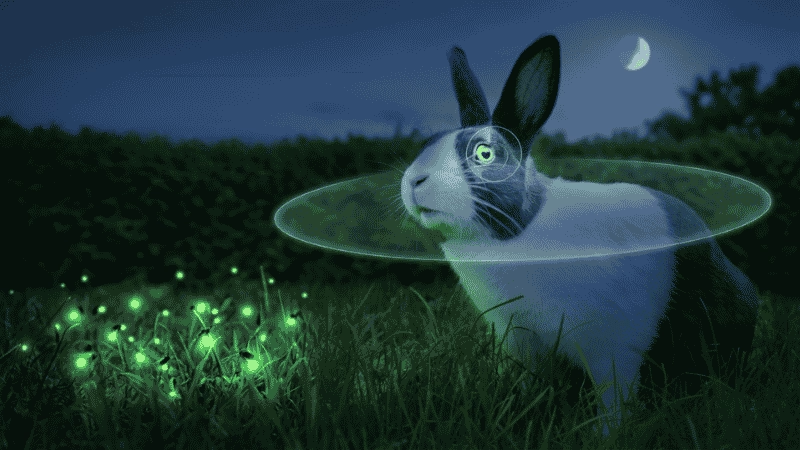
You have probably noticed that your rabbit’s eyes sometimes appear to glow red when light hits them at night. This is called eyeshine.
Unlike cats, rabbits do not have a strong tapetum lucidum. The red glow actually comes from blood vessels in the retina reflecting light. When a bright light shines directly into a rabbit’s eye, you see the red color of the choroidal blood supply.
This explains why rabbit eyeshine looks different from cat eyeshine. Cat eyes glow green or yellow because of the tapetum lucidum. Rabbit eyes glow red because you are seeing blood vessels. The effect is most noticeable in rabbits with albinism or light-colored irises.
A common misconception on Reddit rabbit forums is that red eyeshine means rabbits have excellent night vision. The truth is the opposite. The lack of a tapetum lucidum actually limits their night vision. They see better than humans in dim light, but not nearly as well as true nocturnal animals.
One Reddit user in r/Rabbits noted: “I always thought my rabbit could see perfectly in the dark because his eyes glow red. Then I learned cats have a special reflective layer and rabbits don’t. Now I leave a night light on for him and he seems much calmer.”
For more on how different animals see, including rabbits, check out the BrainFacts article on animal vision.
Rabbit Field of Vision: The 360-Degree View
One of the most remarkable features of rabbit vision is their nearly panoramic field of view. Rabbits have eyes placed high and on the sides of their heads. This allows them to see almost 360 degrees around them without moving their heads.
This wide field of view helps rabbits detect predators approaching from any direction. A hawk flying overhead, a fox sneaking from behind, a dog entering the room. They see it all.
However, this panoramic vision comes with a trade-off. Rabbits have a small blind spot directly in front of their faces, about 10 degrees, and another blind spot under their chins. This explains why your rabbit sometimes cannot find a treat placed right in front of her nose. She is literally looking at a blind spot.
When your rabbit cocks her head to the side to look at you, she is trying to move the object out of her blind spot and into her area of binocular vision. Only about 30 degrees of a rabbit’s field of view is binocular, meaning both eyes see the same image to create depth perception.
Rabbits also have poor depth perception because their eyes face different directions. They use monocular vision most of the time, which is a more two-dimensional representation of the world. This is why rabbits sometimes hesitate before jumping onto a surface. They cannot accurately judge the distance.
Resource from the BBC Science Focus Magazine explains that prey animals like rabbits have eyes on the sides of their heads for a wide field of view.
Quick tip: Always approach your rabbit from the side, not directly from the front. This allows her to see you with her peripheral vision and reduces the startle response.
Can Rabbits See Colors?
The question of color vision often comes up alongside night vision. Rabbits have dichromatic vision. This means they have two types of cone cells in their retinas, sensitive to different wavelengths of light. Humans have three types of cones, giving us trichromatic vision.
p>So what colors can rabbits see? Studies have identified receptor systems in rabbit retinas with maxima at wavelengths of 405 nm (violet), 470 nm (blue), and 523 nm (green). However, behavioral studies suggest that rabbits primarily distinguish between green and blue.Can rabbits see red? Most evidence suggests they cannot distinguish red well. Red likely appears as a shade of gray or brown to rabbits. A study on domestic European rabbits found that their cones are sensitive to either green or blue light but not to red.
Are rabbits color blind? By human standards, yes. They cannot see the full spectrum of colors that humans can. But they are not completely color blind. They can tell the difference between green and blue.
A common observation on Reddit rabbit forums is that rabbits seem to prefer certain colored toys. One user noted: “My rabbit ignores red toys but loves blue and green ones. I thought she was just picky, but now I know she literally cannot see red.”
Research from the University of Miami explains that rabbits have a much higher ratio of rods to cones than humans, giving them better low-light sensitivity at the cost of color discrimination.
How Rabbits See Humans and Detect Movement
Given the limitations of rabbit vision, you might wonder how rabbits recognize their owners. The answer is that they use a combination of senses. Vision plays a role, but not in the way you might think.
p>Rabbits have excellent motion detection. Their rod-rich retinas are highly sensitive to movement. A rabbit can spot a hawk flying overhead or a person walking into the room from a distance. But the image is blurry. They see a moving shape, not detailed features.So can rabbits recognize faces? No, not by sight alone. Your face appears as a blurry shape to your rabbit. She cannot see your smile or your frown. But she recognizes your silhouette, your gait, your voice, and most importantly, your scent.
p>This explains why your rabbit may act calm around you but panic when you wear a hat or carry a large object. Your silhouette changed. She does not recognize the shape. To her, a person with a box looks like a different creature entirely.Reddit rabbit owners frequently share stories of their bunnies thumping at family members wearing new clothes or carrying groceries. One user wrote: “My rabbit thumped at my husband for an hour after he came home wearing a hoodie he never wears. She literally did not recognize him.”
Resource from the RSPCA rabbit behavior guide provides additional information on how rabbits perceive their environment.
How Rabbits Use Other Senses to Compensate
Given the limitations of rabbit vision, especially at night, rabbits rely heavily on their other senses. Their sense of smell, hearing, and whiskers are far more important for daily survival than their eyes.
p>Rabbits have an incredible sense of smell. They have up to 100 million scent receptors in their noses. Humans have about 5 to 10 million. A rabbit can smell predators, food, and other rabbits from a great distance. Your rabbit recognizes you by your scent long before she sees you clearly.Rabbit hearing is also exceptional. Rabbits can rotate their ears independently to detect sounds from multiple directions. They hear frequencies up to 49,000 Hz. Humans top out around 20,000 Hz. Your rabbit can hear sounds you cannot even detect.
p>Whiskers are another critical navigation tool. Rabbit whiskers, called vibrissae, are extremely sensitive to touch and air currents. They help rabbits detect objects in their blind spot, especially directly in front of their faces. Never trim a rabbit’s whiskers. They are essential sensory organs.In our observation, rabbits who lose their vision due to age or illness adapt remarkably well. They rely even more heavily on their whiskers, smell, and hearing. A blind rabbit can still navigate a familiar cage, find food and water, and recognize her owner.
Signs of Vision Problems in Rabbits
Rabbits are masters at hiding illness, including vision problems. Knowing the signs helps you catch issues early.
p>Bumping into objects is the most obvious sign. A healthy rabbit rarely runs into things. Her whiskers warn her. If your rabbit keeps walking into cage walls, furniture, or her food bowl, her eyesight may be failing.Cloudy eyes indicate cataracts. This is common in older rabbits. The lens becomes opaque, blocking light. Rabbits with cataracts have very poor vision and will struggle to see in low light or darkness.
p>Startling easily when approached suggests vision loss. A rabbit with healthy eyesight sees you coming. A blind or nearly blind rabbit does not see you until you touch her or make a loud sound.Disorientation in the cage is another warning sign. Your rabbit may struggle to find her food bowl or water bottle. She might circle in place or seem confused in familiar surroundings.
Resource from the PDSA rabbit health guide provides more information on eye problems.
Final Thoughts
So can rabbits see in the dark? Yes, they see better than humans in low light, but they cannot see in complete darkness. Their eyes are adapted for twilight conditions, not pitch black. Rabbits are crepuscular, meaning they are most active at dawn and dusk. This is when their vision works best.
p>Rabbits have a nearly 360-degree field of view to detect predators. But this comes at the cost of poor depth perception and a blind spot in front of their faces. They see blue and green, but red is invisible to them. Their eyes glow red at night because of blood vessels, not a reflective layer.Understanding rabbit vision makes you a better owner. Approach from the side, not the front. Leave a dim night light on. Choose blue or green toys. Announce yourself with your voice. Small changes based on how rabbits actually see make a real difference in their quality of life.
Trusted Resources for Rabbit Vision and Care
- University of Miami College of Arts and Sciences – Expert guide on rabbit vision
- RSPCA Rabbit Behavior Guide – Veterinary-reviewed advice
- PDSA Rabbit Health – UK veterinary charity guidance
- WabbitWiki Rabbit Eyes – Comprehensive rabbit care wiki
- BrainFacts Animal Vision – Educational resource
You may also find these guides helpful: can a hamster see in the dark and can hamsters see in colour.
FAQ Section: Questions You Might Have
No, rabbits cannot see in complete darkness. They need at least some ambient light to see. Their eyes are adapted for low-light conditions, not pitch black. In total darkness, rabbits rely on their whiskers, sense of smell, and hearing to navigate. Leave a dim night light on for your rabbit.
No, rabbits do not have night vision like cats. Cats have a tapetum lucidum, a reflective layer behind the retina that boosts night vision. Rabbits lack this layer. Their night vision is better than humans but not as good as true nocturnal hunters. Rabbits are crepuscular, meaning they see best at dawn and dusk.
Yes, rabbits can see some colors. They have dichromatic vision, meaning they can distinguish between green and blue. They have difficulty seeing red. By human standards, rabbits are color blind, but they are not completely color blind. They also have some sensitivity to violet wavelengths.
Rabbit eyes glow red because of blood vessels in the retina reflecting light. Unlike cats, rabbits lack a strong tapetum lucidum. The red glow comes from the choroidal blood supply. This does NOT mean rabbits have good night vision. It is simply the reflection of blood vessels.
Yes, rabbits have a small blind spot directly in front of their faces, about 10 degrees wide. They also have a blind spot under their chins. This is why your rabbit sometimes cannot find a treat placed right in front of her nose. When a rabbit cocks her head to the side, she is trying to move the object out of her blind spot.
Rabbits have nearly 360-degree vision. Their eyes are placed high and on the sides of their heads, giving them a panoramic field of view. They can see behind themselves without turning their heads. However, they have poor depth perception and a small blind spot directly in front of their faces.
Rabbits do not recognize their owners by sight alone. Your face appears as a blurry shape to them. However, they recognize your silhouette, voice, scent, and the sound of your footsteps. A rabbit who comes to the front of her enclosure when you walk in is recognizing you using multiple senses, not just vision.
Your rabbit is likely listening, not staring. Rabbit hearing is excellent. What looks like staring at nothing is often intense listening. Your rabbit heard a sound you cannot detect. Freezing and staring is a predator avoidance behavior. She is trying to determine if the sound is a threat.
Signs of vision problems include bumping into objects, cloudy eyes, startling easily when approached, disorientation in the cage, eye discharge, redness, and reluctance to move in low light. Older rabbits commonly develop cataracts. Any sudden change in vision or eye appearance warrants a veterinary visit.
Yes, leave a dim night light on near your rabbit’s enclosure. Total darkness is stressful for rabbits. They need some ambient light to see and feel secure. Avoid bright lights directly on the cage. A small LED night light in the corner of the room works well.